Private beta We're looking for 100 listeners to test Antinodal in their own rooms before launch. · 100 places for testers Apply →
Antinodal
For hi-fi listening rooms

Your room is the first component. Tune it before you upgrade anything.


The leap in sound you're hoping for from your next upgrade is already in your room. Antinodal measures it with your iPhone and tells you what to change, and where — so your system finally gives you everything it has. No external microphone needed.

iPhone 12 Pro or later · LiDAR Free to scan · no account · no snake oil

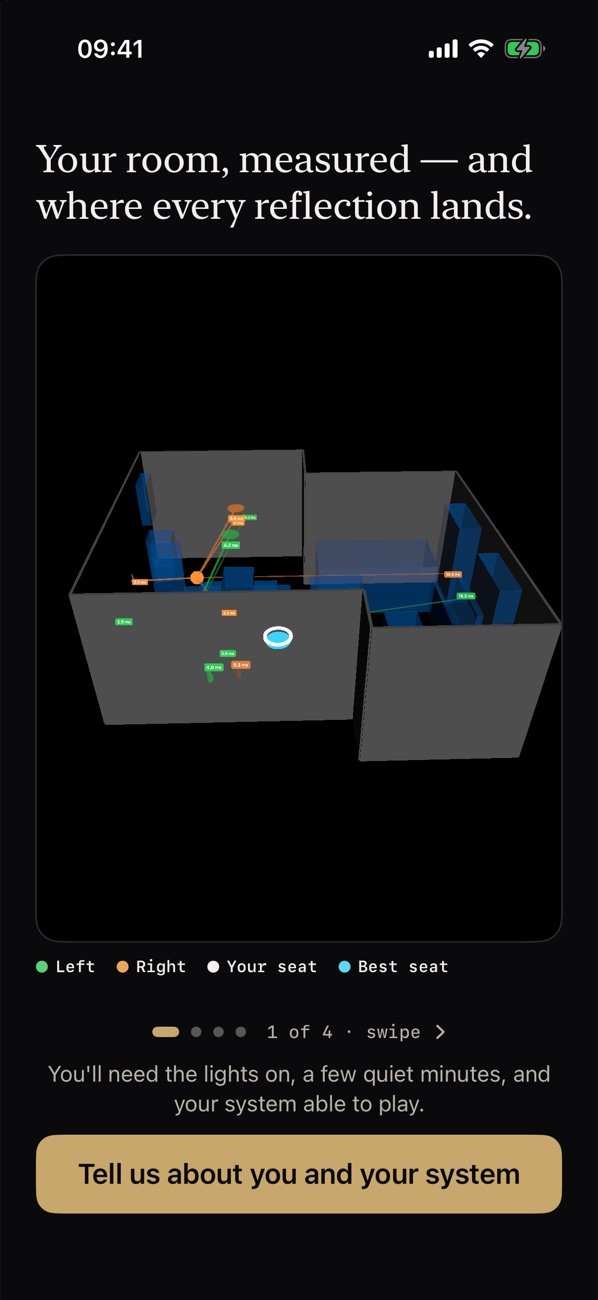
A real living room scanned by Antinodal: walls, furniture, both speakers, the listening seat and the first-reflection points.
The real result for this room Your left wall answers at 4.1 ms, your right at 9.5 ms. → A panel on each side wall. Left: 1.60 m from the front corner, 1.00 m high.
A real listening room, scanned with an iPhone. Drag to turn.
What you get

What you get, from one five-minute run.

These are real screens from the app, measured in a real living room — not mock-ups.

01 · The room

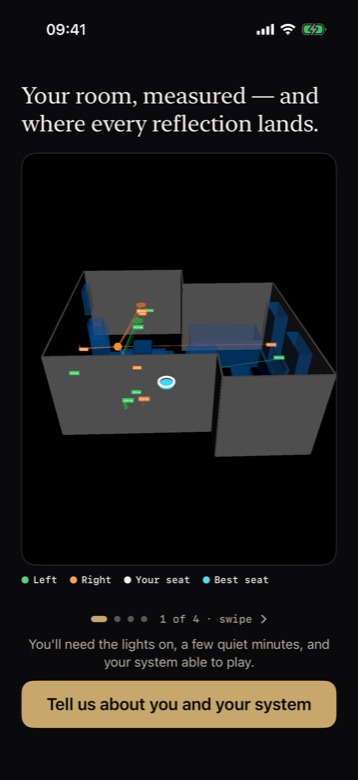
Your room, measured — and where every reflection lands.

A 3D model you can turn in your hand, with your speakers, your seat, and the spot on every wall where a mirror would show you a speaker. That spot is where a panel does its work.

LiDAR scan · first reflections · bass nulls
The 3D room model with the left and right speakers, the listening seat and reflection points on the walls.
02 · Stereo balance

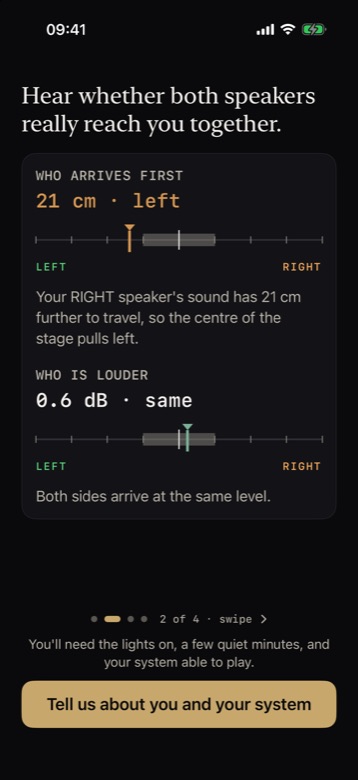
Hear whether both speakers really reach you together.

Your phone listens to your own system from your seat. It can tell one speaker arriving 0.45 ms before the other — about 15 cm of path — and says which way to move.

Arrival time · level · treble, left against right
Two meters: who arrives first, 21 cm to the left; who is louder, 0.6 dB, the same.
03 · Reverb

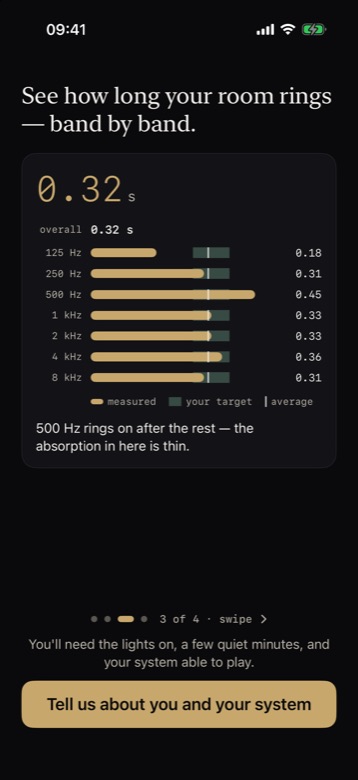
See how long your room rings — band by band.

Measured, not guessed from the furniture — and judged against the sound you told us you like: analytical, natural or enveloping.

RT60 by octave, 125 Hz – 16 kHz
Reverberation time by band: 0.32 seconds overall, with 500 Hz ringing on longer than the rest against the target band.
04 · What to do

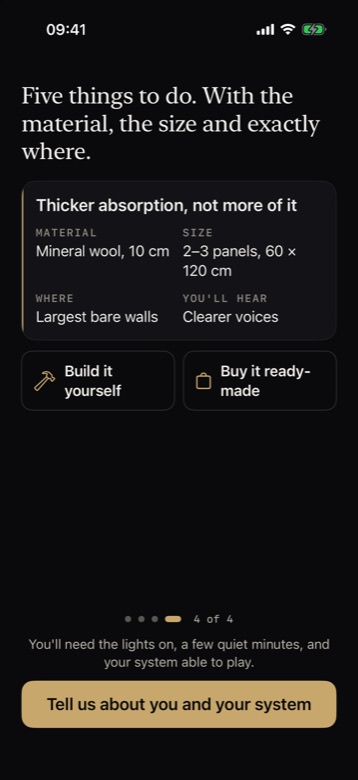
Five things to do. With the material, the size and exactly where.

Not a wall of findings. Five moves ranked by what you'll hear, each located with a tape measure from two walls — and how to build it yourself, or where to buy it.

Ranked recommendations · DIY or ready-made
A recommendation: thicker absorption, not more of it — mineral wool, 10 cm; two to three panels of 60 by 120 cm; on the largest bare walls; you'll hear clearer voices. Build it yourself, or buy it ready-made.
05 · Measure again

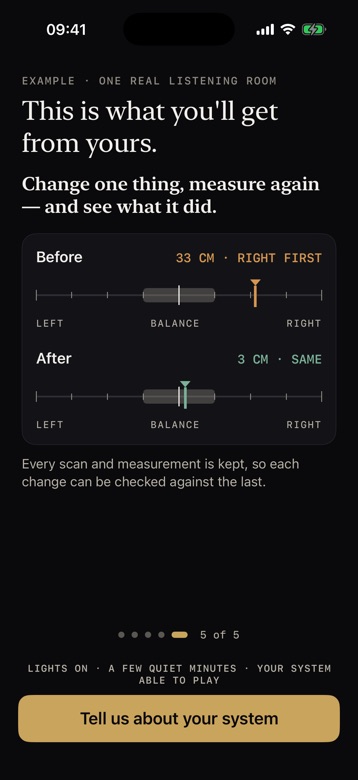
Change one thing, measure again — and see what it did.

This is the whole idea. Move the chair, turn a speaker, hang a panel — then measure again. Every scan and every measurement is kept, so each change is checked against the last. Not a promise: a before and an after.

Every result kept · before against after
Before: 33 cm, right first. After: 3 cm, the same — the needle back inside the grey band.
Measure · change one thing · measure again

Twenty centimetres you can hear — and see.

The loop at the heart of Antinodal, from countless tests in a real living room: electrostatic panels, two metres apart. Measured, the chair moved, measured again — same system, same phone, a few minutes apart. Nothing else changed. This is a real before and after, not an illustration.

Plan of the listening position Two speakers two metres apart at the top, and the listening seat below them. Before, the seat sits about 20 centimetres toward the right speaker; after, it sits on the centre line. LEFT RIGHT YOUR SEAT ≈ 20 cm

Voices lean to the right.

Who arrives first0.96 ms · right first

The left speaker's sound has 33 cm further to travel, so the centre of the stage pulls right.

Who is louder6.1 dB · right louder

Sitting nearer the right speaker makes it louder, too — the image leans twice.

The grey band is what a phone can honestly separate. Inside it, we call the two sides equal.

Another evening, another small thing. A vase of flowers came off the front of the left panel. The app heard that side's treble come back by 2.2 dB at 8 kHz — and the speaker hadn't moved an inch.

An afternoon's work

The same room, optimised for how you listen. Same equipment, a different experience.

A typical living room, and the four changes Antinodal most often asks for — each with its exact place. Every number on it is worked out with the app's own acoustics.

Illustration of a typical room — not a customer's. Drag to turn.

    Why the room

    The best system in the world, ruined by four walls.

    Bass

    Notes that boom, and notes that vanish.

    The room resonates between its walls. Sit in the wrong spot and whole bass notes disappear — no amplifier brings them back.

    Image

    A voice that won't stay in the middle.

    One speaker reaching you a fraction of a millisecond first, a side wall answering too soon — and the stage leans and smears.

    171Hz

    Put a speaker 50 cm from the wall behind it and the reflection off that wall cancels it at about 171 Hz — the body of a kick drum, the chest of a male voice. No cable fixes that. Moving the speaker does.

    How it works

    Measured in five minutes. Useful the same afternoon.

    One guided run, in the order your room asks for it. The app tells you what to do at every step, and every step can be redone on its own later.

    1. 01

      Mark your speakers

      Aim at each speaker and tap. The app pins them to the room itself, so the marks stay put while you move.

      Under a minute
    2. 02

      Walk the room

      The LiDAR scanner in your iPhone maps the walls, openings and furniture as you walk. Then you sit down where you listen.

      Two to three minutes
    3. 03

      Sit and listen

      The phone plays a tone to hear how long your room rings. Then your own system plays a sweep, left then right, and the phone listens from your seat.

      About a minute and a half

    Then: five things to do, in order of how much you'll hear them.

    Honest by design · no snake oil

    An iPhone, as a measuring instrument? For some things — and we say which.

    Honesty isn't our small print; it's the product. The LiDAR scanner measures your room to the centimetre. The microphone is uncalibrated, so we use it only where calibration doesn't matter: comparing — left against right, this seat against that one, before against after — and timing how long the room rings.

    What it measures

    • Your room's shape, speakers and seat, to the centimetre
    • Which speaker reaches you first — down to about 15 cm of path
    • How long the room rings, band by band, 125 Hz – 16 kHz
    • Which bass notes boom and which vanish at your seat, 30 – 250 Hz
    • Where every first reflection lands, and when

    What it doesn't measure

    • A sound level in dB. An uncalibrated mic can't honour one — the comparisons are what tell you what to change
    • What a surface is made of. It can't tell plaster from a curtain, but it sees exactly where each reflection lands
    • How many dB a bass note booms or drops. It hears which notes misbehave, not by how much

    Our honesty pledge

    01

    We tell you what you'll notice. Then you check it yourself, by measuring again.

    02

    If a measurement goes wrong, we say so. If your phone moved, the result tells you in a yellow box — and gives no advice from it.

    03

    Free moves come first. Every treatment comes with how to build it yourself; the shop is one option of two.

    04

    The advice can't be bought. No maker pays to change what Antinodal recommends.

    Room first, DSP after

    Most audiophiles agree: treat the room first, and add digital room correction afterwards only if you still need it. Antinodal does the first part. It never sits in your audio chain — no DSP, no EQ — and everything it recommends is physical: where things stand, and what goes on the wall.

    The full account of what a phone can — and can't — measure →

    By listeners, for listeners

    Born in real listening rooms.
    Not in a lab.

    Antinodal is made by people who spend their evenings in the sweet spot, for people who do the same. No manufacturer behind it, no product to push — just the room, measured honestly.

    A real listening room: electrostatic panels, the listening chair and the equipment.
    Where every build is tested first.

    Awkward shapes. Open sides. Speakers the LiDAR can barely see.

    The hardest rooms to get right are the ones people actually live in, so that's where Antinodal was built. Countless tests, until marking a speaker worked every time. Every figure checked against a tape measure, and when the app and the tape disagreed, the app changed.

    • IndependentNo brand behind us. Advice never changes for anyone.
    • Physical, not digitalNo DSP, no EQ. Everything we suggest, you can do with your hands.
    • Shaped by listenersThe private beta decides what ships next.
    Who's behind it
    “I'd rather give you five good recommendations than fill your screen with findings.” John · Founder

    Join the listeners in the private beta →

    Pricing

    Free to scan. One purchase for the rest.

    No subscription. See your room before you pay a thing.

    Free

    Always
    • The room scan and its 3D model
    • Where every first reflection lands
    • How long your room rings, as one figure
    • Your stereo balance at a glance

    Antinodal Full

    One purchase · price at launch · free for beta testers
    • Five ranked recommendations — build it yourself or buy it ready-made
    • Reverb band by band, against the sound you want
    • Stereo balance figures: timing, level and treble
    • The bass-null map, and where your chair should be
    • Before and after: every change you make, compared
    • More than one room
    iPhone12 Pro or later Pro / Pro Max — the models with LiDAR
    iOS26.2 or later
    Your systemAirPlay, or any player that can play a file: USB stick, Roon, a NAS
    Questions

    Before you ask.

    Can I improve my room's acoustics without building work?

    Yes. Most of what Antinodal recommends first costs nothing: moving a speaker a few centimetres, moving your chair, matching the toe-in. When treatment would help, it tells you exactly what, how big and where — usually a panel that hangs on a hook.

    Do I need a measurement microphone?

    No. Antinodal uses the iPhone's own microphone, and only for what an uncalibrated microphone does well: comparisons — left against right, before against after — and how long the room rings. If you already own a calibrated mic and love curves, keep using them; Antinodal is for the listener who wants the answer.

    Which iPhones does it work on?

    An iPhone Pro or Pro Max from the iPhone 12 Pro onwards — the models with a LiDAR scanner — running iOS 26.2 or later. The scanner is what measures your room to the centimetre.

    Does it work with my system?

    With any stereo system. The reverb measurement needs nothing but the phone. For stereo balance your own system plays a test sweep: send it over AirPlay, or play our sweep file from a USB stick, Roon, a NAS or any streamer — the phone just listens.

    How long does it take?

    About five minutes for the whole room: under a minute to mark your speakers, two or three minutes walking the room, and a minute and a half sitting still in your seat. Each part can be redone on its own — after you move something, for example.

    What kind of recommendations does it give?

    Where your chair should be to avoid bass nulls and centre the image; how far your speakers should stand from the wall behind them; whether both are placed and aimed alike; where panels go for the first reflections, always in pairs; whether your absorption is too thin; and where not to put a subwoofer. Five at a time, ranked by what you'll hear.

    Does it work in a small room or a shared living room?

    Yes — it was built in one: an L-shaped living room with an open side. It works around the furniture you're keeping, and shows separately what it would do with a free hand, so you can see what your constraints cost you.

    Can a phone measure bass?

    Yes — the part that decides what you do. With bass sweeps played through your own speakers, the phone hears which notes boom and which vanish at your seat, from 30 to 250 Hz. Antinodal also works out from your room's shape where the bass cancels across your floor, and labels that as calculated. Together they tell you where your chair, your speakers and your bass traps should go. You can check it yourself: play a steady bass line and walk slowly toward the speakers. You'll hear yourself walk out of the null.

    Are you paid to recommend products?

    No. Every recommendation is complete without a shop — material, size, exact position — and comes with instructions to build it yourself. Ready-made suppliers are listed as a convenience, and if a link ever pays a commission, the app says so right beside it.

    What happens to my data?

    There's no account. Your scans and recordings stay on your phone unless you choose to share them. Read the privacy policy.

    Founding listeners · 100 places

    Be one of the first hundred rooms.

    We're opening Antinodal to 100 listeners before launch. You scan your room, run the full measurement with your own speakers, and tell us what you found. Your findings shape the app.

    You'll need an iPhone with LiDAR: 12 Pro or any later Pro or Pro Max.

    In return
    • Antinodal Full, free, when it launches.
    • Your name on the Founding listeners page, if you want it there.
    • New versions before anyone else, through TestFlight.
    What we ask
    • One complete measurement of your room.
    • Five short questions afterwards.

    100 places

    Right away: changes that improve any listening room

    A tape measure, a mirror, twenty minutes. No app needed.

    Help us tune Antinodal on real rooms.

    Settings → General → About → Model Name.

    We'll email you once to confirm your address. Then we use your answers to choose testers and to send your invitation. Nothing else unless you ticked the box above. Privacy

    Almost there: check your inbox and confirm your email.

    While you wait:

    Changes that improve any listening room →